(510) 493 - 2484

amanahacademyca@gmail.com

(510) 493 - 2484

amanahacademyca@gmail.com

Islamic Worldview

Common Approaches to Curriculum

Common Approaches to Curriculum

All school curricula includes the tangible content that is taught through lessons and the intangible content that is learned from the intentional or unintentional class community and school-wide culture. There are three main ways that Islamic schools approach Islamic content and values: appended curriculum, informal policies, and curriculum integration.

In the appended approach, which is by far the most common, schools use the mainstream secular curriculum along with separate Arabic, Quran and Islamic studies classes. This method isolates the tools, such as Arabic, from the study of Islamic knowledge. It can lead children to compartmentalize teachings, and to learn to view religious content as irrelevant to 'real' life. They may come to believe the secular curriculum, which is more dominant, consistent and overreaching, is better equipped in helping them make sense of the world. They are likely to end up with two incompatible worldviews.

In informal policies, there is often a focus on character or value-based education and Muslim culture. By relying on general principles, schools hope to circumvent the issues that arise from isolating the Quranic and other Islamic sciences from the rest of the student's schooling experience. These policies are meant to introduce Islamic teachings through informal opportunities and teaching moments. This could look like, for example, highlighting the importance of Muslim 'scientists' and their inventions in a science or social studies class, calculating the distance between Safa and Marwa in a math class, or assigning a school-wide monthly character trait. Since this approach is constrained within the secular curriculum, it is inherently very difficult for schools to organize a cohesive, consistent, and meaningful Islamic education over the span of a student's school life.

The third approach, curriculum integration, is the most recent and most ambitious attempt to integrate Islamic principles, values and teachings into modern schooling. Schools redesign the curriculum at the level of lesson plans, objectives, and assessments for the purpose of providing deeper and more meaningful learning experiences. In principle, curriculum integration offers several advantages over the other two approaches. However, in practice, most schools run into insurmountable difficulties in attempting to implement it sustainably and effectively across the grades. 

It is not just the tangible secular curriculum that is problematic.  Schools also have to grapple with the intangible culture inherent in the design of the modern schooling system. It quickly becomes very clear that conventional schooling, as is, cannot accommodate other perspectives, at least not in a cohesive and meaningful way.

All school curricula includes the tangible content that is taught through lessons and the intangible content that is learned from the intentional or unintentional class community and school-wide culture. There are three main ways that Islamic schools approach Islamic content and values: appended curriculum, informal policies, and curriculum integration.

In the appended approach, which is by far the most common, schools use the mainstream secular curriculum along with separate Arabic, Quran and Islamic studies classes. This method isolates the tools, such as Arabic, from the study of Islamic knowledge. It can lead children to compartmentalize teachings, and to learn to view religious content as irrelevant to 'real' life. They may come to believe the secular curriculum, which is more dominant, consistent and overreaching, is better equipped in helping them make sense of the world. They are likely to end up with two incompatible worldviews.

In informal policies, there is often a focus on character or value-based education and Muslim culture. By relying on general principles, schools hope to circumvent the issues that arise from isolating the Quranic and other Islamic sciences from the rest of the student's schooling experience. These policies are meant to introduce Islamic teachings through informal opportunities and teaching moments. This could look like, for example, highlighting the importance of Muslim 'scientists' and their inventions in a science or social studies class, calculating the distance between Safa and Marwa in a math class, or assigning a school-wide monthly character trait. Since this approach is constrained within the secular curriculum, it is inherently very difficult for schools to organize a cohesive, consistent, and meaningful Islamic education over the span of a student's school life.

The third approach, curriculum integration, is the most recent and most ambitious attempt to integrate Islamic principles, values and teachings into modern schooling. Schools redesign the curriculum at the level of lesson plans, objectives, and assessments for the purpose of providing deeper and more meaningful learning experiences. In principle, curriculum integration offers several advantages over the other two approaches. However, in practice, most schools run into insurmountable difficulties in attempting to implement it sustainably and effectively across the grades. 

It is not just the tangible secular curriculum that is problematic.  Schools also have to grapple with the intangible culture inherent in the design of the modern schooling system. It quickly becomes very clear that conventional schooling, as is, cannot accommodate other perspectives, at least not in a cohesive and meaningful way.

The Amanah Academy Approach

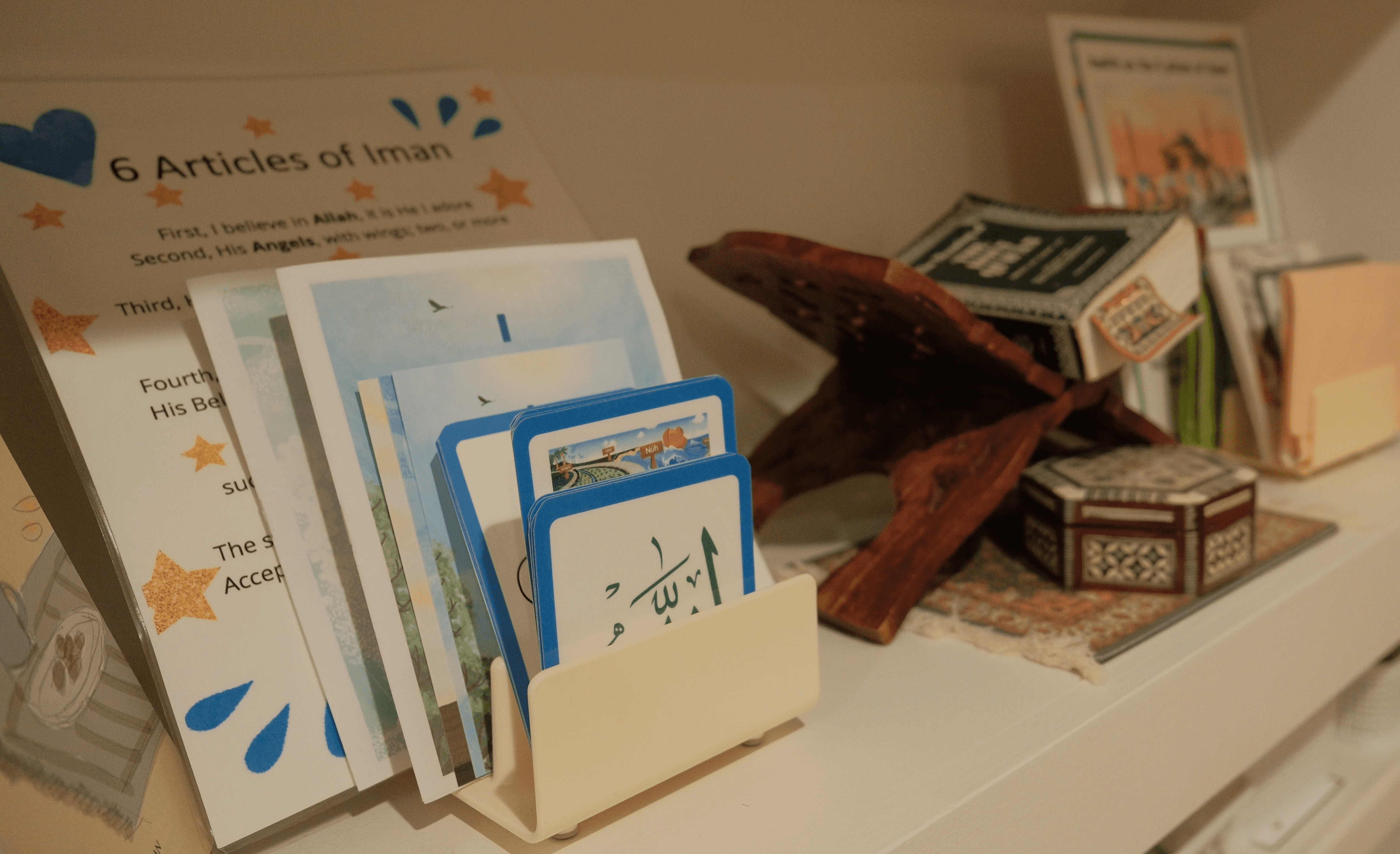
Our approach takes the integration method further by anchoring both the intangible and the tangible aspects of the curriculum to the Islamic worldview. Unlike the mainstream method, Montessori education provides us with an alternative framework that is more accessible and open to curriculum integration at a deeper and more meaningful level. Philosophically, Montessori education is focused on individual potential and community cohesion, which makes the framework more aligned with the greater aims of Islamic education. In methodology, features such as individualized lessons, three-year multi-age groupings, and emphasis on community building allow the holistic integration of the Islamic worldview into the intangible curriculum. In addition, we are able to provide individualized, age-appropriate lessons in the Islamic sciences such as Quran, Arabic, and fiqh and reinforce those teachings through community practice and culture.

For more details, please refer to each program's curriculum page:
Early Childhood

Lower Elementary


Welcome to our small school with a big heart!

Near Pleasant Hill Library

510-493-2484

amanahacademyca@gmail.com

LIC #073409896

ABOUT US

Amanah Academy offers a comprehensive holistic Muslim education within a caring community.

Now Accepting 2026-2027 School Applications

APPLY NOW

© 2026 Amanah Academy

Welcome to our small school with a big heart!

Near Pleasant Hill Library

510-493-2484

amanahacademyca@gmail.com

LIC #073409896

ABOUT US

Amanah Academy offers a comprehensive holistic Muslim education within a caring community.

Now Accepting 2026-2027 School Applications

APPLY NOW

© 2026 Amanah Academy

Welcome to our small school with a big heart!

Near Pleasant Hill Library

510-493-2484

amanahacademyca@gmail.com

LIC #073409896

ABOUT US

Amanah Academy offers a comprehensive holistic Muslim education within a caring community.

© 2026 Amanah Academy